Ever looked at a digital character and felt something was slightly off? Even if you couldn’t find the exact issue? Getting realistic ai anatomy right is key to making a character truly lifelike.
When creating figures, keeping their structure right is crucial. This guide will help you move from static images to figures that move naturally.
By following these steps, you’ll grasp the basics of human form. You’ll make sure your projects stay anatomically precise at every step, no matter how complex your designs.
Key Takeaways
- Understand the core principles of human proportions to avoid common visual errors.
- Learn how to maintain structural integrity during the character generation process.
- Bridge the gap between static poses and fluid, lifelike motion.
- Apply a systematic checklist to verify your work for consistent quality.
- Improve your digital output by mastering the basics of realistic ai anatomy.
Establishing the Foundation of Realistic AI Anatomy
To avoid mistakes in AI art, you need to understand the human body’s geometry. Getting a realistic ai anatomy is not just luck. It’s about knowing the math behind our bodies. This knowledge helps you control your art better.
Understanding Human Proportions and the Eight-Head Rule
The “eight-head rule” is a key for human height. In art and anatomy, adults are about 7.5 to 8 head lengths tall. This rule is crucial for your art.
“Proportion is the heart of beauty, and without it, even the most detailed image will feel fundamentally wrong to the human eye.”
Remembering this ratio helps avoid figures looking too short or too long. Consistency is key for a professional look in your digital art.
Identifying Common AI Generation Distortions
Even top models face challenges with complex body parts. You’ll see glitches that ruin the realistic ai anatomy look. Spotting these early helps you fix issues before wasting time.
- Limb distortion: Extra joints or missing fingers are common in complex poses.
- Perspective errors: The AI may struggle to maintain consistent scale between foreground and background elements.
- Anatomical misalignment: Shoulders or hips may appear disconnected from the spine.
Setting Up Your Workspace for Anatomical Precision
To get a realistic ai anatomy, treat your workspace like a studio. Start with high-quality references, like anatomical sketches or 3D models. Having these on your secondary monitor helps you compare your work to real bodies.
Make your digital space easy to use. Keep your favorite negative prompts and style modifiers ready. This way, you can work faster and keep your art quality high. Precision starts with preparation, making sure every piece is based on reality.
Mastering Skeletal Structure and Bone Landmarks
The secret to avoiding common errors in anatomy ai porn generation lies in your ability to map the underlying skeletal structure accurately. Think of the skeleton as the primary blueprint for your digital subjects. When this framework is misaligned, the entire figure loses its sense of realism and physical presence.
Mapping the Ribcage and Pelvic Alignment
The ribcage and pelvis act as the two main anchors for the human torso. You must ensure these structures align correctly to maintain a believable center of gravity. If the ribcage tilts too far from the pelvic basin, the pose will appear physically impossible or distorted.
Focus on the spatial relationship between these two masses. When you visualize them as solid blocks, you can better control how the spine curves between them. This alignment is vital for creating figures that look grounded rather than floating in space.
Ensuring Correct Joint Placement for Natural Poses
Identifying specific bony prominences is the most effective way to anchor your joints. Key landmarks such as the clavicles, iliac crests, and the acromion process provide the necessary data points for natural movement. By locking these points in place, you prevent the limbs from drifting into unnatural positions.
Proper joint placement ensures that limbs bend at the correct hinges. This attention to detail is what separates a high-quality render from a flawed one. Always verify that your joints align with these skeletal markers before finalizing your pose.
Avoiding Limb Elongation and Extra Digits
Limb elongation and extra digits are frequent issues in anatomy ai porn workflows. These glitches often occur when the AI lacks a clear understanding of where a bone ends and a joint begins. You can mitigate these errors by enforcing strict constraints on limb proportions during the generation process.
| Landmark | Function | Impact on Pose |
|---|---|---|
| Clavicle | Shoulder Support | Prevents shoulder collapse |
| Iliac Crest | Pelvic Stability | Maintains core balance |
| Acromion | Arm Rotation | Ensures natural limb flow |
By focusing on these structural foundations, you gain better control over your output. Mastering these landmarks will significantly reduce the need for manual corrections later. Consistent practice with these skeletal rules will lead to much more professional results in your anatomy ai porn projects.
Refining Musculature and Soft Tissue Dynamics
To make your digital creations look real, you need to understand how muscles and soft tissue work together. A photoreal body isn’t just about shape; it’s about how the inside affects the outside.
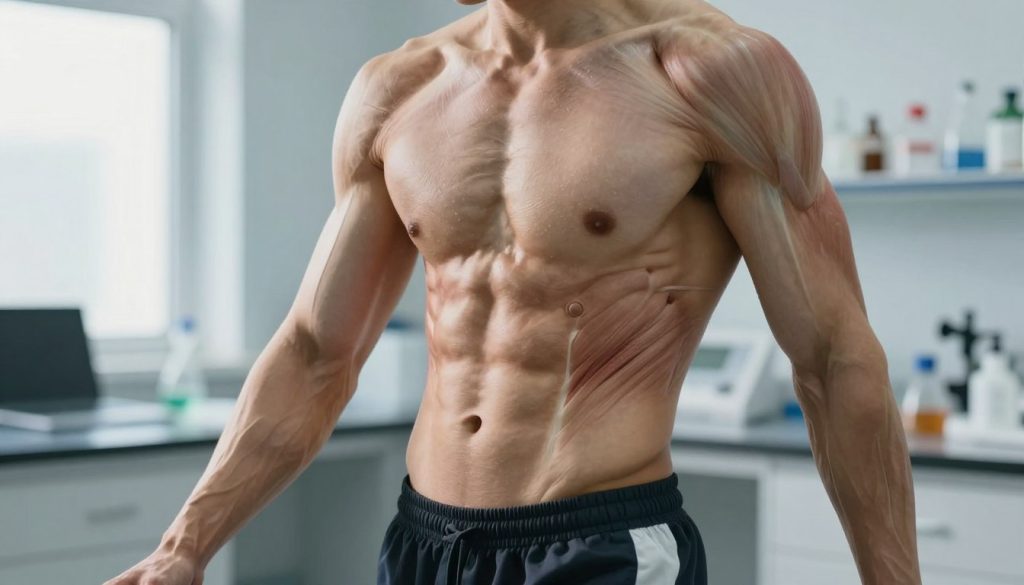
Layering Muscle Groups for a Photoreal Body
Muscles shape the body’s surface. Layering them right gives your model depth and a convincing human shape. Without this, your model might look flat or fake.
- Identify primary muscle groups like the pectorals, deltoids, and quadriceps.
- Ensure that muscle volume transitions smoothly into tendons and ligaments.
- Use anatomical references to verify that the muscle mass matches the character’s pose.
Simulating Skin Tension and Fat Distribution
How skin looks depends on what’s under it. You need to show how fat is spread out to make your photoreal body look natural.
When muscles are tense or relaxed, skin tension changes. Adjusting these settings helps avoid a fake look. Subtle variations in fat around joints and the torso make your model look real.
Managing Surface Details and Texture Mapping
The last step is to add surface details that make human skin look real. Texture mapping should include pores, fine lines, and small imperfections for a photoreal body.
“True realism is found in the details that the eye often overlooks, such as the way light scatters across the skin’s surface.”
Make sure your texture maps match the muscle structure. When surface details follow muscle flow, you get a highly believable and professional character model.
Achieving Fluid Motion and Dynamic Posing
Moving beyond static images means mastering weight and gravity. Creating believable movement is more than just a good prompt. It requires understanding how the human body shifts its center of mass.
Applying the Principles of Weight and Balance
Every dynamic pose needs a clear weight distribution. If your character leans, their center of gravity must match the foot they’re standing on. This avoids the look of falling. Proper weight distribution makes the image feel grounded and real.
Watch how hips and shoulders tilt in opposite directions. This natural balance is what makes human movement fluid. Without it, your figures might look stiff or robotic, no matter the skin texture.
Correcting Joint Compression in Extreme Angles
Extreme poses can be tough for AI to handle. Sharp bends might cause unnatural folds or lose the shape of elbows and knees. Spotting these issues early is key.
To fix these problems, tweak your prompt to highlight the skeletal structure at the joint. Targeted inpainting can also help refine skin tension around these areas. By manually correcting these points, you keep the character’s silhouette realistic, even in tough poses.
Maintaining Anatomical Integrity During Movement
Keeping consistency is the biggest challenge in animating or posing a character. Limbs must keep their proportions as they move to avoid the “stretching” effect. This is crucial in anatomy ai porn, where accuracy is expected.
Always ensure the forearm’s length matches the upper arm in extreme reaches. If the AI distorts limbs, simplify the pose before trying more complex movements. Maintaining structural integrity is essential for top-notch results.
| Pose Type | Weight Focus | Common Risk |
|---|---|---|
| Standing | Centered | Symmetry issues |
| Leaning | Offset | Loss of balance |
| Dynamic Action | Momentum | Joint compression |
| Reclining | Distributed | Limb elongation |
Advanced Techniques for Photoreal Body Generation
To create a photoreal body that looks real, you need to be very careful. Basic prompts can make figures that look human, but for true realism, you must do more. Using professional methods ensures your images are accurate in every detail.
Utilizing Reference Models for Consistent Anatomy
For consistent results, use real data instead of just AI guesses. Anatomy books and 3D scans are the best for checking muscle and bone placement. By comparing your images with these models, you can fix small mistakes in size or shape.
AI can struggle with complex poses without a clear guide. A reference model keeps your photoreal body correct, no matter the angle. This is key for a professional look in your work.
Balancing Lighting and Shadow to Define Form
Lighting is key for showing depth and volume in a photoreal body. Shadows highlight muscles and skin, making the figure look alive. Aim for lighting that shows off bone details well.
Stay away from even lighting, as it hides important details. Use light sources to create soft gradients on the skin. This makes the body look three-dimensional and hides AI mistakes.
Refining Extremities and Facial Symmetry
AI often struggles with hands, feet, and faces. Focus on making these parts look right. Facial symmetry is especially important, as small mistakes can ruin the illusion.
When AI gets hands or feet wrong, use special tools to fix them. Work on each part separately to get the details right. This meticulous attention to detail is what makes AI art look professional.
Navigating Complex Anatomical Challenges in AI
To achieve a realistic ai anatomy, you need a smart plan. This plan helps fix common errors and distortions. When creating complex poses, you’ll face specific challenges that need manual help or better prompts.
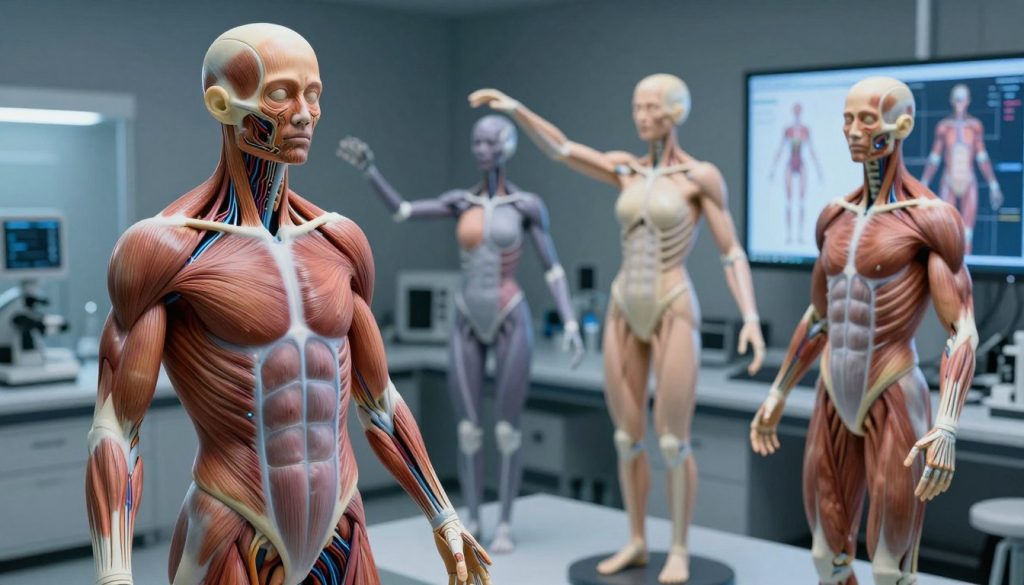
Handling Overlapping Limbs and Occlusion
One big problem is when limbs overlap. This makes the AI lose track of bones. It often results in extra digits or limbs that blend into the body. To solve this, clearly state the depth of each limb in your prompt.
Using specific words for where each part is helps the AI get it right. If it still fails, try breaking the pose into simpler parts. This keeps anatomical integrity intact.
Managing Perspective Distortion in Close-up Shots
Close-up shots can cause perspective distortion. This makes faces or hands look wrong. The AI has trouble with the right focal length for these shots. To fix this, ask for a wider angle or use a measurement guide to keep things right.
If anatomy looks stretched, try changing the output’s aspect ratio. A balanced frame helps the AI not have to guess as much. This leads to a more realistic ai anatomy.
Troubleshooting Common Generation Glitches
Glitches often happen when the AI gets body positioning wrong. If limbs bend in weird ways, it means the AI doesn’t know the joint’s limits. Use negative prompts to avoid these deformities.
| Common Error | Primary Cause | Recommended Fix |
|---|---|---|
| Limb Merging | Occlusion confusion | Use depth-specific prompts |
| Warped Proportions | Perspective shift | Adjust camera focal length |
| Extra Digits | Surface detail noise | Apply negative prompts |
| Joint Dislocation | Poor skeletal mapping | Use reference models |
By tackling these glitches, you keep your work top-notch. Regular practice will improve your realistic ai anatomy in all projects.
Optimizing Prompts for Anatomical Consistency
Using precise language is key to creating accurate images. It helps guide the model, especially with anatomy ai porn. This ensures that every part of the body is correct.
Structuring Descriptive Prompts for Body Parts
To get great results, describe body parts clearly. Start with the overall pose and then get into details like muscle shape or joint position.
Clear communication is crucial. Use specific terms like “defined deltoids” or “natural pelvic tilt.” This helps avoid common mistakes.
“The quality of your output is directly proportional to the clarity of your input. If you define the frame, the AI will fill it with precision.”
Using Negative Prompts to Eliminate Deformities
Negative prompts help keep your work accurate. They tell the AI what not to include, avoiding common errors.
Use specific terms like “extra digits” or “distorted joints” in your negative prompts. This is key for complex scenes where anatomy ai porn might get messy.
| Category | Positive Prompt Focus | Negative Prompt Focus |
|---|---|---|
| Extremities | Five fingers, natural grip | Extra fingers, webbed hands |
| Joints | Correct articulation, hinge | Double joints, broken bones |
| Proportions | Eight-head rule, symmetry | Elongated limbs, distortion |
Iterative Refinement Strategies for Better Results
Don’t expect perfection on the first try. View the process as an iterative cycle of testing and tweaking. Start broad and add details as needed.
If a part is still off, focus on it next. This way, you can improve your overall consistency. With practice, creating detailed anatomy ai porn will become easier.
Post-Processing and Manual Correction Workflows
To get a photoreal body, you need more than just AI. Modern models are good, but they miss the small details that make human bodies unique. A structured post-processing workflow helps bridge this gap, making your digital art look top-notch.
Integrating AI Outputs with Digital Sculpting Tools
Start with a base AI generation. Then, import it into ZBrush or Blender for detailed control. Use corrective shape keys or blend shapes to fix areas that look off. This ensures your photoreal body looks right, even in tough poses.
With sculpting tools, you can smooth out rough edges or fix bone details the AI got wrong. Adding these touches by hand gives you full control over the final look. This is key for artists who need perfect anatomy in their work.
“The machine provides the canvas, but the artist provides the soul. True realism is found in the deliberate correction of the machine’s minor oversights.”
Using Inpainting to Fix Anatomical Errors
Inpainting is great for fixing small issues without redoing the whole image. If a limb or joint looks wrong, mask it and use a prompt to fix it. This keeps the overall image intact while improving the photoreal body details.
When inpainting, focus your prompts on the exact area you want to correct. For example, if a hand has an extra finger, mask it and use a prompt like “anatomically correct human hand.” This method saves time and keeps the rest of the image intact.
Final Touches for Professional-Grade Realism
The last step is to make sure the lighting and texture match. Apply color grading and skin texture overlays to make your photoreal body look real and connected to its setting. These small tweaks can turn a good image into a masterpiece.
| Tool Category | Primary Function | Best For |
|---|---|---|
| Digital Sculpting | Mesh Deformation | Correcting Joint Structure |
| Inpainting | Localized Generation | Fixing Anatomical Glitches |
| Color Grading | Lighting Harmony | Achieving Photorealism |
By using these manual techniques regularly, your work will stand out. Remember, the goal is to improve AI output, not replace it. With practice, these steps will become second nature, helping you create high-quality art efficiently.
Conclusion
Learning about human anatomy is a journey that never ends. It mixes technical skills with the ability to see things clearly. By knowing a lot about bones and muscles, you can make AI pictures look amazing.
Practicing a lot is key to getting better. Using top-notch references from places like ArtStation or Adobe Stock helps a lot. This way, you can make sure your work looks real.
Being good at human anatomy makes your work stand out. Try new things with tools like Blender or ZBrush. Also, share your work with others to get new ideas.
Keep learning about how technology and biology work together. Every time you try something new, you get closer to making perfect models. Your hard work makes your characters touch people’s hearts.
FAQ
How can I apply the “Eight-Head Rule” to ensure a photoreal body in AI generation?
To get a photoreal body, start with a base size. An adult is about 7.5 to 8 head lengths tall. This helps avoid AI generation distortions like too long torso or legs. It keeps your character looking believable.
What are the most effective ways to avoid limb elongation and extra digits?
To avoid limb and digit errors, learn about skeletal structure and joint placement. Use ControlNet in Stable Diffusion to set up ribcage and pelvic alignment right. Spotting bony prominences like clavicles and iliac crests helps the AI stay accurate.
Why is understanding skin tension and fat distribution important for anatomy ai porn?
In anatomy ai porn, being true to life matters a lot. How muscle groups and soft tissue dynamics work is key. It’s about how fat distribution and skin tension change with pose. Without it, the skin looks flat, not alive.
How do I fix joint compression that occurs during dynamic posing?
Joint compression can make elbows or knees look wrong at extreme angles. Use reference models from Sketchfab to see how weight and balance affect shape. Adjusting lighting and shadow in post-processing can also help.
What role do negative prompts play in maintaining anatomical consistency?
Negative prompts help keep the AI from making mistakes. By telling it not to create “fused limbs,” “extra fingers,” and “deformed anatomy,” you ensure accuracy. This is key for top-notch results.
How can I manage perspective distortion and occlusion in close-up shots?
Perspective distortion can mess up facial symmetry and extremities when the camera is too close. Use high-quality reference materials and inpainting techniques to fix overlapping limbs or occlusion errors.
Can I use digital sculpting tools like ZBrush to improve AI-generated anatomy?
Yes, using digital sculpting tools like ZBrush or Blender is advanced. You can refine the muscle groups and skeletal framework manually. Then, bring it back to an AI tool for texture mapping and final touch-ups.
How does lighting and shadow help define the form of a generated character?
Lighting and shadow are crucial for defining form and creating depth. Balancing highlights on bone landmarks and deep shadows in muscle valleys adds anatomical precision. It makes the photoreal body seem real.