Ever wondered how top creators get their visuals so perfect? It’s all about mastering the hidden layers of your software. By going beyond basic tweaks, you can reach a new level of professional-grade precision. This changes your whole workflow.
Working with a realistic ai porn editor is more than just clicking buttons. You need to understand how masks and rotoscoping tools work with your material. When you get good at using these tools, you control every frame.
This guide will show you how to use advanced post-production techniques easily. Whether you’re refining edges or polishing your final work, these skills are key for top-notch results. Let’s explore the technical side of your creative process.
Key Takeaways
- Mastering masks and rotoscoping is vital for professional visual control.
- Advanced workflows allow you to move past simple, automated adjustments.
- Precision tools help you achieve a polished, high-quality final output.
- Understanding software layers significantly improves your creative efficiency.
- Technical mastery is the key to elevating your digital content production.
Getting Started with Your Realistic AI Porn Editor
Your journey into high-end digital production starts with optimizing your workstation. A clean and efficient environment is key. Organizing your digital space early helps avoid workflow slowdowns.
Setting Up Your Workspace
Make sure your hardware can handle modern AI software. High-performance components prevent system crashes. Consistency in your file structure is crucial for managing projects.
Create a dedicated folder for each project. This habit prevents data loss and keeps your assets ready for editing. Use the table below to check if your hardware is up to the task.
| Component | Minimum Requirement | Recommended Spec |
|---|---|---|
| Graphics Card | 8GB VRAM | 16GB+ VRAM |
| System RAM | 16GB | 32GB or higher |
| Storage Type | SSD | NVMe SSD |
Importing High-Resolution Assets
Working with high-resolution assets is crucial for visual fidelity. These files help AI algorithms accurately match skin tones and textures. Always check your source files before importing.
When importing high-resolution assets, ensure your project settings match the source. Mismatched settings can cause artifacts. Proper preparation helps your realistic ai porn editor perform at its best.
Understanding the Precision Editor Interface
A well-organized workspace is key for every project. Using a precision editor nsfw lets you work with visuals accurately. This skill helps you focus on creativity, not the software.
Navigating the Timeline and Layers
Managing layers well is crucial for complex projects. Think of your timeline as a stack where top layers show first. Organizing assets helps keep things clear, even when editing is tough.
Track mattes are a powerful tool. They use a separate layer for a precise cut-out effect. This lets you control what’s visible and transparent, making your work look smooth.
“Efficiency is doing things right; effectiveness is doing the right things.”
Customizing Toolbars for Efficiency
Customizing your interface saves time. Most suites let you pin favorite tools to the main toolbar. This layer management keeps your space tidy and key tools easy to find.
Feel free to change your panels to fit your workflow. When your precision editor nsfw matches your habits, you click less. Streamlining your interface boosts your daily output and quality.
Mastering Masking Techniques for NSFW Content
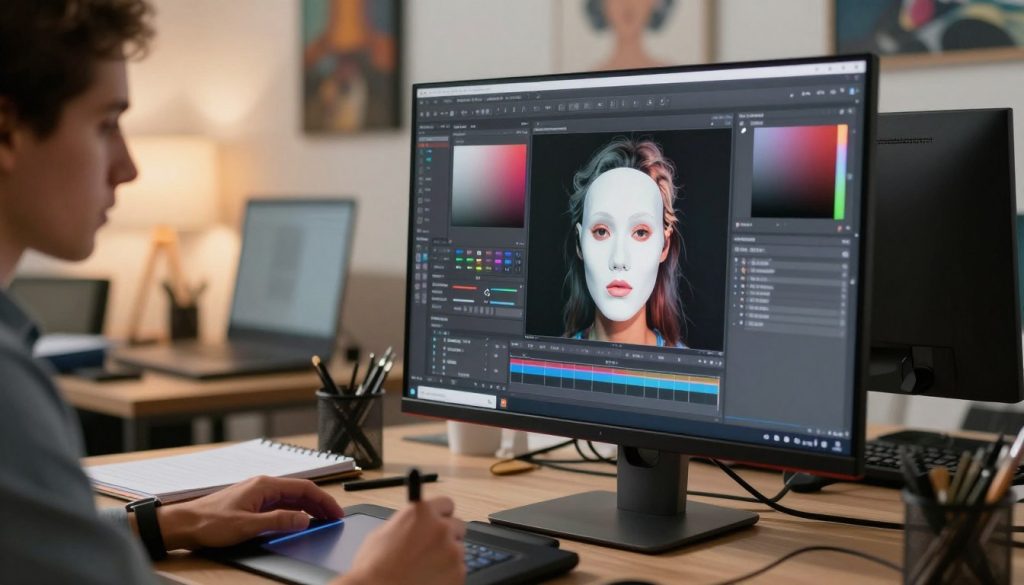
Visual effects (VFX) need precise control over frames. In a precision editor nsfw setting, masking is key. It helps isolate and modify parts without changing the whole image. This skill keeps your work realistic and high-quality.
Creating Precise Selection Masks
First, you need to set the boundaries of your subject. Vector-based tools help draw sharp paths around complex shapes. Precision is crucial for skin and detailed textures, as small mistakes can ruin the edit.
“The secret to invisible editing lies in the quality of your masks; if the edges are perfect, the audience will never know the image was altered.”
Adjusting Feathering and Opacity
After setting your selection, you must soften the edges. Feathering makes the mask’s edges smooth, hiding digital changes. Adjusting opacity helps the modified layer blend with the original footage.
| Masking Tool | Primary Use | Edge Control |
|---|---|---|
| Pen Tool | Hard-edged objects | High Precision |
| Brush Mask | Organic shapes | Soft/Variable |
| Luma Key | Brightness isolation | Automatic |
Using Soft Masks for Skin Blending
For skin, hard masks look fake. Soft, gradient-based edges blend color corrections or textures with skin tones. This is key for a natural look in visual effects (VFX), especially in precision editor nsfw suites.
Advanced Rotoscope Workflows
When automated tools can’t handle complex motion, you need to use manual rotoscoping workflows. To get perfect video compositing, you must dive deep into manual tracing. This ensures every edge is sharp and accurate.
Frame-by-Frame Tracking Basics
Frame-by-frame tracking means manually setting an object’s boundaries in each frame. It’s crucial for subjects that move unpredictably or blend with the background.
Using onion skinning helps keep things consistent. It lets you see the previous and next frames at the same time. This makes it easier to get your paths right.
- Find the keyframes where the object changes direction.
- Start tracing with lots of anchor points for the first shape.
- Adjust the handles to fit the subject’s natural curves.
Utilizing AI-Assisted Motion Tracking
Today’s software has AI tools that guess movement patterns to help you work faster. These tools look at pixel data to suggest path changes. This makes your work go quicker.
But, these tools aren’t perfect. Treat their suggestions as a starting point. Especially in scenes with fast motion or changing lights.
Correcting Drift in Complex Movements
Drift happens when tracking data gets off track over time. You need to manually correct it to keep your visual effects (VFX) in sync.
Pro-tip: Divide your tracking into smaller parts to avoid mistakes. If the mask starts to slip, add a new keyframe. This keeps your final product looking professional and clean.
Refining Edits with Polish Tools
Refining your work is key to making simple clips into top-notch visuals. The first step sets the structure, but the final touches make it stand out. By paying attention to the small details, every frame becomes intentional and polished.
Color Grading and Skin Tone Matching
Color grading is crucial for a unified look in your project. You need to balance the light and dark areas so everything looks perfect together.
Matching skin tones is all about the details. Use vectorscopes to keep skin tones consistent, even when the lighting changes. Consistency is what makes a production look high-end.
Applying Texture Overlays for Realism
To succeed in video compositing, you need to blend digital and real-world footage. Adding texture overlays, like film grain, makes AI elements look more real.
These textures make the edit feel organic and real. A light texture layer helps the final product look natural.
Smoothing Transitions Between AI Layers
When working with layers, the edges can show the digital nature of the edit. Use feathering to make these edges soft, blending elements into the background.
Adjusting the opacity of top layers also helps with smooth transitions. This keeps your video compositing seamless, making it seem like one shot.
| Technique | Primary Benefit | Impact Level |
|---|---|---|
| Color Grading | Visual Consistency | High |
| Texture Overlays | Organic Realism | Medium |
| Edge Feathering | Seamless Blending | High |
Integrating AI Enhancements into Your Edit Suite
You can make your productions better by adding smart AI features to your edit suite. Using new tech, you can turn regular footage into stunning visuals. These visuals will grab attention in a busy market.
This move lets you explore new creative ideas while keeping your workflow smooth. Using these tools means your final product will meet today’s high standards.
Upscaling and Sharpening Techniques
Upscaling is key when you start with low-res footage in your edit suite. Smart algorithms can fill in missing pixels. This makes your clips look sharper.
Adding sharpening filters makes edges clearer and brings out fine details. Your image will be sharp and clear, even on big screens.
Managing AI Generation Parameters
Getting good at AI-assisted editing means finding the right balance. You need to adjust settings to match your vision.
Changing things like noise reduction and style strength lets you control the look. This precision is key for keeping your project consistent. With careful management, AI can enhance your work without losing your artistic touch.
Troubleshooting Common Editing Artifacts
Even the most skilled editors sometimes face visual artifacts that can ruin their work. These small errors can pull your audience out of the story. To master post-production editing, you need a sharp eye and patience to fix these tiny mistakes.
Working with AI-assisted editing can lead to unwanted halos or semi-transparent outlines. These issues, like edge fringing and ghosting, happen when the software can’t tell the subject from the background. Fixing these problems often involves a slight matte choke or tweaking spill suppression settings.
Fixing Edge Fringing and Ghosting
To get a clean look, use edge refinement tools to soften or tighten the selection mask. If you see a bright fringe, try changing the edge color to match the background. This makes the subject blend seamlessly into the scene.
Always check your work at full resolution to avoid introducing new artifacts. Over-processing can cause pixelation, so keep your changes small. Consistency is key to keep your video looking realistic.
Resolving Flickering in Rotoscoped Areas
Flickering occurs when the software can’t track movement well across frames. This creates a jittery effect that breaks the flow of your AI-assisted editing. To fix it, manually adjust keyframes where the tracking goes wrong.
Using a temporal smoothing filter can also help. It averages the mask position over frames, hiding minor jumps. Proper edge refinement during rotoscoping saves time in the final render.
| Artifact Type | Primary Cause | Recommended Fix |
|---|---|---|
| Edge Fringing | Poor Mask Contrast | Apply Matte Choke |
| Ghosting | Motion Blur Mismatch | Adjust Opacity Curves |
| Flickering | Tracking Instability | Temporal Smoothing |
Best Practices for High-Quality Output
Your final output is the bridge between your vision and the audience’s experience. The creative phase is vital, but the post-production editing workflow must end with technical precision. This ensures your content looks great on every screen. Skipping the final delivery stage can lessen the impact of your hard work.
Optimizing Export Settings for Web
Finding the right balance between file size and visual quality is key to export optimization. Use high-efficiency codecs like H.264 or H.265 to keep things clear and fast. Make sure your frame rate and resolution match the platform you’re targeting to avoid quality loss.
“Quality is never an accident; it is always the result of high intention, sincere effort, intelligent direction and skillful execution.”
Here’s a table to help you pick the right settings for your distribution:
| Platform | Recommended Codec | Target Bitrate | Resolution |
|---|---|---|---|
| Web Streaming | H.264 | 10-15 Mbps | 1080p |
| Mobile Apps | H.265 | 5-8 Mbps | 1080p |
| Archival | ProRes 422 | High (Variable) | 4K |
Maintaining Consistency Across Projects
Consistency is key for a professional creator. Use custom presets and templates to keep your visual style the same across all projects. This saves time and strengthens your brand in your audience’s eyes.
Have a standard naming convention and folder structure for all assets. Applying the same export optimization rules to every project cuts down on errors. Reliability in your output process is what sets pros apart from amateurs in the digital world.
Conclusion
Being a precision editor means you need both technical skills and creativity. You now know how to make raw footage look great with masking and rotoscoping.
Practicing regularly is key to getting better. Try out different settings in Adobe Premiere Pro or DaVinci Resolve. See how small changes can make a big difference.
Being able to fix mistakes and keep things looking consistent is important. Keep up with new AI tools that come out. They can help you do your job better.
Showing your work to others can help you see things from new angles. Your path to making great content is always evolving. Keep exploring and improving to get the best results.
FAQ
How can I streamline my workflow when using the precision editor nsfw for complex projects?
To work more efficiently, customize your toolbars. This keeps important functions close at hand. Learning to use the timeline and track mattes helps manage complex layers.
What is the most effective way to achieve seamless skin blending in my edits?
Use masking to focus on specific parts of the image. Create precise masks and adjust the feathering to smooth out edges. This makes your VFX look natural and seamless.
How do I handle difficult tracking tasks when automated tools fail?
For tough tracking, switch to manual rotoscoping. Use onion skinning to track motion accurately. This keeps your subject aligned in the sequence.
What steps are necessary to match AI-generated layers with real-world footage in an edit suite?
To blend AI layers with real footage, focus on color grading and skin tone matching. Add texture overlays to match the original footage’s grain. This ensures a polished, realistic finish.
How can I fix common artifacts like edge fringing or flickering in my final render?
Edge fringing and ghosting can be fixed by refining masks and tweaking AI settings. To stop flickering, track each frame consistently. Optimize export settings to keep your work clear during web delivery.
Why is upscaling and sharpening important for high-quality visual effects?
Upscaling and sharpening are key for keeping details when mixing low-res AI with high-def projects. Tools like Topaz Video AI can improve AI clarity, matching your high-res assets.