Ever thought about making digital characters feel real? As we move into 2026, digital art is changing fast. Now, you can create detailed, lifelike experiences that were once dreams.
This guide is your realistic ai porn roadmap for advanced creative work. Learn to use real-time video for smooth, realistic interactions that grab your audience’s attention right away.
We’ll dive into managing scenes with many characters and adding virtual reality. Get ready to boost your skills and make your production smooth and professional.
Key Takeaways
- Mastering real-time rendering is key for today’s digital projects.
- Multi-actor scenes need precise timing and top-notch software.
- Virtual reality adds a new level of depth for your viewers.
- Creating high-quality content relies on optimizing AI workflows.
- Keeping up with 2026 tech keeps your content ahead of the game.
Setting Up Your Hardware Infrastructure
Building a strong hardware infrastructure is key for modern generative models. Your machine needs to handle big datasets quickly and accurately. This roadmap ai porn guide helps keep your system up-to-date with the latest tech.
Selecting High-Performance GPUs for AI Rendering
Your setup’s heart is the GPU performance. Look for cards with lots of VRAM for better scene quality. NVIDIA’s CUDA architecture is top-notch for most generative software.
At least 16GB of VRAM is a must to avoid slowdowns. For bigger projects, think about using two GPUs to share the workload.
Optimizing Local Storage and Memory Bandwidth
Quick data access is vital for large models. Use NVMe SSDs for fast loading times. Slow drives can really slow you down, especially when switching scenes or characters.
Also, make sure your system has enough RAM for background tasks. DDR5 memory ensures your GPU gets the data it needs without pause.
Cooling and Power Management for Sustained Workloads
AI rendering can take a long time, which means it gets hot. A good power supply unit (PSU) keeps your system stable. A reliable PSU stops crashes that can waste hours of work.
Good airflow is also crucial for GPU performance. Choose a case with strong fans or liquid cooling to avoid overheating. Keeping your hardware cool means better quality work all the way through your project.
| Component | Entry Level | Professional Grade | Recommended |
|---|---|---|---|
| GPU VRAM | 12GB | 24GB+ | 24GB |
| Storage | SATA SSD | Gen5 NVMe | Gen4 NVMe |
| System RAM | 32GB | 128GB | 64GB |
| PSU Rating | 750W Gold | 1200W Platinum | 1000W Gold |
Mastering Realistic AI Porn Roadmap Fundamentals
Your journey to high-quality results starts with generative AI basics. To get professional results, you need to go beyond simple prompts. Understanding how images are made is key. A realistic ai porn roadmap helps your skills grow with the tech.
Understanding Latent Diffusion Models
Latent diffusion is at the core of today’s image making. These models start with a noisy image and clean it up until it’s clear and detailed. They work in a space that’s not pixel-based, keeping things efficient and detailed.
Knowing latent diffusion lets you control the final image better. You can tweak how the model handles noise. This skill is essential for any good image-making strategy.
Fine-Tuning Checkpoints for Anatomical Accuracy
Getting human anatomy right takes more than a good prompt. You often need to fine-tune models to grasp body shapes and skin textures. Precision is key to avoid mistakes like wrong limbs or skin.
Using top-notch datasets for fine-tuning boosts the model’s human form rendering. This step is crucial for keeping poses and lighting consistent. Consistent anatomical rendering makes your work stand out.
Developing Consistent Character LoRAs
Low-Rank Adaptation, or LoRA, keeps character identity consistent. It’s a key part of your realistic ai porn roadmap. Without it, keeping a character’s look the same in different scenes is hard.
To create a good LoRA, gather diverse images of your character. Consistency is the ultimate goal. This way, your character looks the same in any setting. Mastering this lets you create complex stories easily.
Selecting the Right Generative Models
Your choice of generative models is key to every visual project’s success. The model you pick sets the quality of your visuals and how much control you have. Knowing the strengths of different models helps keep your work smooth and professional.
Evaluating Open-Source Versus Proprietary Architectures
In the world of AI generation, you face a choice between open-source and proprietary models. Open-source models let you see the code and make changes as needed. This is great for creating custom pipelines or unique styles.
On the other hand, proprietary models are easy to use and powerful. But, they might not let you tweak certain settings. Your decision should be based on whether you want simplicity or detailed customization.
Utilizing Stable Diffusion XL and Flux for Realism
For top-notch realism in latent diffusion, Stable Diffusion XL and Flux are top picks. They’ve been trained on huge datasets, making them experts in lighting, anatomy, and texture.
Stable Diffusion XL is great for high-resolution images, while Flux is best for following complex prompts. Using these tools, you can create images that look real and authentic. They’re the go-to for creators who need top-quality results.
Leveraging Specialized Models for Skin Texture and Lighting
While general generative models are good, they can be improved. Specialized models for skin texture and lighting can take your work to the next level. These models help make your images look like they were taken in real life.
These tools let you control small details like how light scatters under the skin. This level of detail is what makes your work stand out. The table below compares these models to help you choose for your next project.
| Model Category | Primary Strength | Best Use Case | Control Level |
|---|---|---|---|
| Open-Source | Customization | Complex Pipelines | High |
| Proprietary | Speed/Ease | Rapid Prototyping | Low |
| Specialized | Detail/Texture | Final Rendering | Medium |
| Latent Diffusion | Versatility | General Creation | High |
Implementing Real-Time Video Generation Workflows
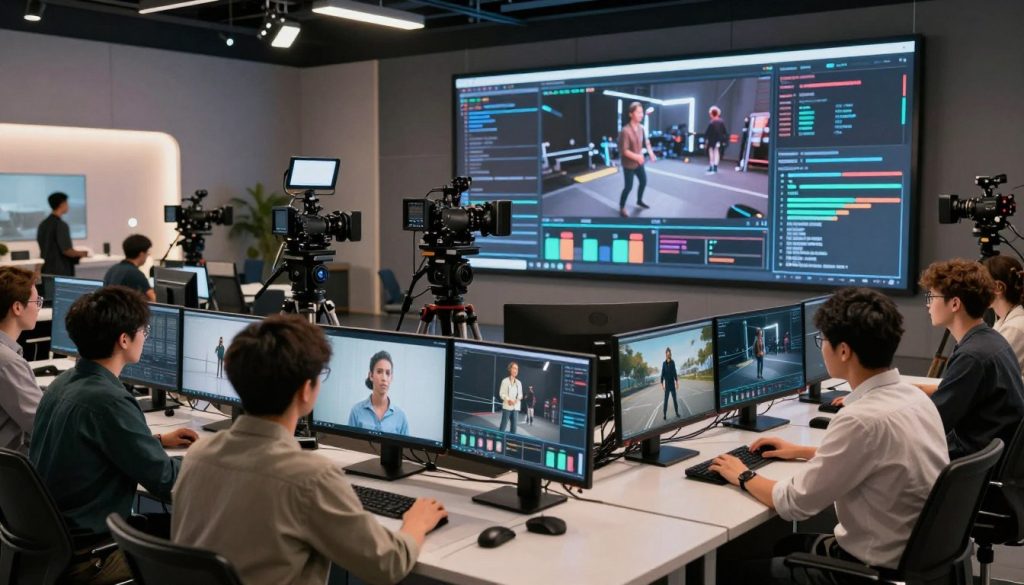
Modern AI workflows push the limits of real-time visual production. They make it easier to go from starting to finishing a project quickly. This is key for keeping high-quality video without losing detail.
Configuring ComfyUI for Streamlined Video Pipelines
ComfyUI is a key tool for advanced AI generation projects. Its design makes it easy to work on complex videos. By cutting down on data transfers, you can make your workflow faster and smoother.
- Cache intermediate latents to save processing time.
- Use lightweight checkpoints for rapid previewing.
- Implement custom nodes to automate repetitive generation steps.
Utilizing AnimateDiff for Fluid Motion
Getting natural movement in real-time video is all about timing. AnimateDiff helps make your videos look smooth. By choosing the right motion settings, your characters will move smoothly, not jerkily.
Try out different motion models to see what works best for your project. When set up right, these tools help your characters act consistently. This is important for top-notch AI generation.
Synchronizing Audio and Visual Output
The last hurdle is making sure sound and video are perfectly in sync. This is what keeps your video from feeling choppy. You need to keep your video and audio perfectly timed.
Good AI workflows focus on keeping everything in sync. By watching your buffer health, you can adjust things on the fly. This level of detail is what makes a project look professional.
Orchestrating Complex Multi-Actor Scenes
Creating multi-actor scenes is more complex than single-character scenes. It needs a mix of technical skill and creative vision. This ensures all characters act naturally together.
Managing Spatial Relationships Between Characters
The main challenge is keeping characters in the right places. They must be on different planes to avoid depth issues.
Using a consistent system helps place actors correctly. Clear boundaries for each character prevent mixing of features during generation.
Applying ControlNet for Pose Consistency
ControlNet is key for keeping scenes structured. It uses OpenPose to set the skeletal structure before generation starts.
This method ensures precise control. It gives the model a clear guide for each actor’s position and movement. This reduces the chance of body distortions.
Layering Actors to Prevent Clipping and Artifacts
Layering is vital to avoid visual problems. Actors are rendered on separate layers and combined later.
This method stops characters from overlapping. Proper masking keeps each actor distinct, improving the final image quality.
| ControlNet Model | Primary Function | Best Use Case |
|---|---|---|
| OpenPose | Skeletal tracking | Complex character interaction |
| Depth Map | Spatial positioning | Maintaining background depth |
| Canny Edge | Structural outline | High-detail clothing and props |
| Segmentation | Layer isolation | Preventing actor clipping |
Integrating VR Environments for Immersive Experiences
You can now make a big leap from flat AI images to immersive experiences with smart spatial mapping. Meta Horizon OS is growing its developer community, and the need for top-notch AI content is soaring. Learning this process lets you turn still images into interactive, exploreable worlds.
Mapping AI Assets to 360-Degree Spherical Projections
To get a smooth look, you need to turn your AI images into equirectangular projections. This means wrapping your 2D images around a spherical shape. Proper alignment is key to avoid seams at the poles of your 360-degree scene.
Make sure your aspect ratio is exactly 2:1 when preparing these assets. This ensures your textures fit perfectly on the inside of your virtual sphere without distorting the center.
Optimizing Depth Maps for VR Headset Compatibility
Depth maps are crucial for your headset to figure out depth and position. Without them, your immersive experiences might feel flat or cause eye strain. You should create depth maps with clear contrasts to show the distance between objects and the background.
Always check that your depth values match your virtual scene’s scale. If the depth is too shallow, objects will seem to float. If it’s too deep, the scene’s scale will feel off, ruining the sense of presence.
Creating Interactive Environments with Unreal Engine 5
Unreal Engine 5 is the top choice for VR development, with great tools for lighting and physics. By bringing your mapped assets into the engine, you can add interactive parts that respond to movement. This makes your space feel alive, not just a static image.
| Feature | Standard Rendering | VR Integration |
|---|---|---|
| Spatial Depth | Simulated | Real-time Parallax |
| User Interaction | None | Physics-based |
| Performance Load | Low | High |
Using Nanite and Lumen in the engine keeps your visuals sharp, even in detailed scenes. This mix of AI textures and engine-level interactivity is the future of VR development for solo creators.
Optimizing Latency for Real-Time Performance
Latency is a big problem when making immersive experiences. High-resolution AI assets need a lot of power, which can cause delays. These delays can ruin the feeling of being there. Getting past these technical challenges is key for great VR development.
To make motion smooth, you need to improve your hardware infrastructure. This means making your system handle big tasks better. By doing this, you can make sure each frame matches the user’s actions. This stops motion sickness caused by delays.
Reducing Inference Time Through Model Quantization
Quantization makes your model weights less precise to speed up calculations. Changing models from FP32 to FP16 or INT8 cuts down memory use. This drastic reduction lets your GPU work faster without losing quality.
Leveraging TensorRT for Faster Generation
NVIDIA TensorRT is a key tool for making deep learning models run better on your machine. It looks at your network and makes it work more efficiently. Using TensorRT means your hardware infrastructure runs at its best during live sessions.
Balancing Resolution Against Frame Rate Requirements
Choosing between clear images and fast output is tough. In VR development, keeping a steady frame rate is more important than high resolution. Frames dropping can mess up the experience. So, focus on keeping it smooth rather than super clear.
| Optimization Method | Primary Benefit | Complexity Level | Performance Gain |
|---|---|---|---|
| INT8 Quantization | Lower VRAM Usage | Moderate | High |
| TensorRT Fusion | Faster Inference | High | Very High |
| Resolution Scaling | Stable Frame Rate | Low | Medium |
Enhancing Visual Fidelity with Upscaling Techniques
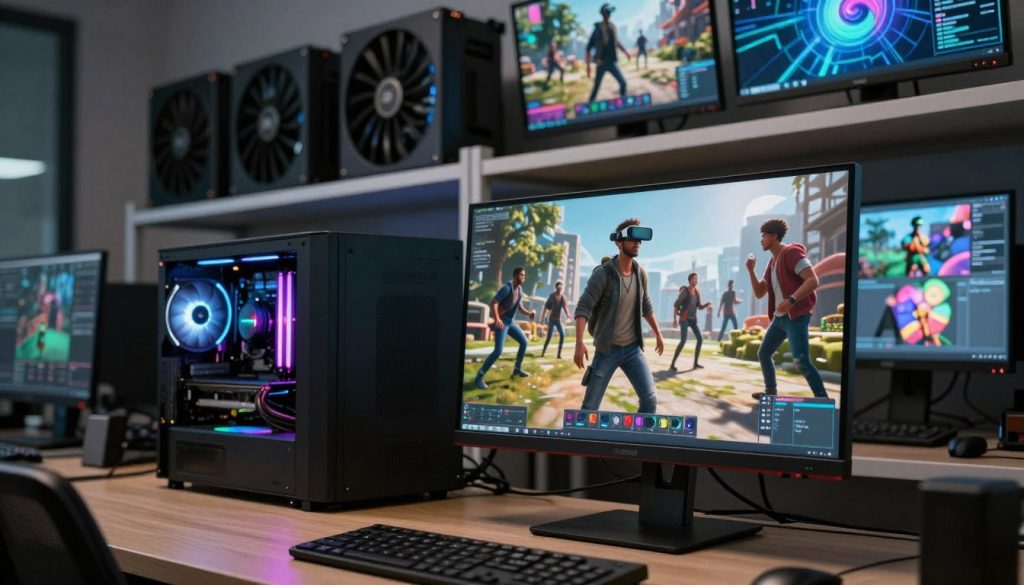
Turning low-resolution drafts into high-definition masterpieces is key in your workflow. To achieve visual fidelity, you need a balance between raw power and smart software. Modern upscaling methods help you use your GPU performance well, without losing quality.
Applying Real-Time Super-Resolution Filters
Real-time super-resolution filters sharpen images as they’re made. They guess missing pixel data, making images clearer without slowing down. Efficiency is key for fast video.
Choose filters that fit into your workflow to avoid delays. This keeps your system fast, even when rendering complex scenes. With the right setup, these filters greatly improve image quality without needing new hardware.
“Technology is best when it brings people together and enhances the creative vision of the artist.”
Correcting Facial Features with Post-Processing Models
Even with high-resolution images, facial details need extra care. Post-processing models refine these details, making them look natural. They focus on eyes, skin, and mouth to ensure anatomical accuracy.
Using these models after the main generation lightens the load. This keeps your work looking sharp throughout. It’s a smart way to fix small issues that could ruin a frame.
Maintaining Texture Consistency During Upscaling
Upscaling can lose fine details. It’s important to keep textures consistent across frames to avoid flickering. Temporal-aware models help keep textures steady during movement.
Keep an eye on your GPU performance to avoid slowdowns. A well-optimized system lets you keep high-quality textures while working fast. Consistency is what makes a project look professional.
Managing Data Privacy and Ethical AI Practices
To build a sustainable future for digital projects, focus on data security and ethical AI. Generative tools are getting smarter, so protect your work and your subjects’ privacy. This sets a strong foundation for success.
Securing Your Local Generation Environment
Your local setup is key to protecting your work. Run models offline to keep your data safe. This reduces the chance of unauthorized access.
- Implement robust firewall rules to restrict outbound traffic from your GPU workstations.
- Use encrypted storage solutions to protect your model checkpoints and LoRA files.
- Regularly audit your software dependencies to patch vulnerabilities that could expose your system.
Understanding Consent and Ethical Content Creation
Building immersive experiences starts with trust. Ethical content creation is crucial for your reputation. Make sure you have explicit consent for all data used.
Transparency is key for a healthy ecosystem. Here’s a table to check your practices:
| Practice | Risk Level | Action Required |
|---|---|---|
| Data Sourcing | High | Verify clear consent |
| Model Training | Medium | Anonymize datasets |
| Output Usage | Low | Apply clear labeling |
Managing Metadata and Digital Watermarking
Tracking your content’s origin is now crucial. Meta is improving trust signals, showing the need for provenance. Use standardized metadata to identify your work.
Digital watermarking is a great way to protect your work. It embeds invisible markers in your videos. This keeps your immersive experiences authentic and builds trust.
Troubleshooting Common Generation Artifacts
Even top AI systems can sometimes make visual mistakes. These errors might slow you down, but they often mean your model needs a bit of tweaking. Learning to fix these issues is key to being a pro.
Fixing Morphing and Texture Flickering
Morphing and flickering happen when the model changes too much between frames. To fix this, try lowering your denoising strength and keeping the seed the same. Tools for stabilizing motion can also help keep textures steady.
- Increase the sampling steps to improve frame-to-frame coherence.
- Utilize motion modules that prioritize temporal consistency.
- Apply post-processing filters to smooth out jittery transitions.
Resolving Lighting Inconsistencies Between Frames
Lighting changes often because the model sees the scene differently in each frame. Use a reference image or a steady light map to guide the AI. Consistency is the key to immersion, and stable lighting avoids distracting changes.
“The quality of your final output depends heavily on the stability of your initial parameters and the precision of your guidance inputs.”
Addressing Anatomical Distortions in Multi-Actor Scenes
Working with multi-actor scenes is tricky, as the model might mix up limbs. Use advanced masking to keep each actor separate. This stops the AI from mixing up features.
For lasting anatomical errors, try ControlNet models to keep the skeleton right. Good planning and testing are crucial for quality. Remember, ethical AI means taking time to refine your work, avoiding errors that spoil the view.
Future-Proofing Your AI Content Strategy
The world of digital content is always changing. You need to plan ahead for your production goals. As synthetic media tech gets better, being able to change quickly will help you succeed.
Having a strong future plan is now a must. It’s not just for quality output, but for staying ahead in the market.
Adapting to Rapidly Evolving Generative Architectures
The industry changes fast, making old ways of working outdated quickly. You should be ready to try new generative models as soon as they come out. Having a flexible setup lets you update easily without starting over.
This flexibility helps you add new features without stopping work. Keep up with the latest research and community updates. This way, your roadmap ai porn stays current. Don’t rely too much on one tool that might become outdated.
Building Scalable Automation Pipelines
Being efficient is key for a creative business to grow. Automating tasks like processing and tagging saves time for creative work. A scalable pipeline means you can grow with your audience.
Make scripts that manage files and rendering queues for you. This reduces mistakes and keeps your generative models consistent. With automation, you can focus on improving your art, not just managing tech.
Staying Ahead of Hardware and Software Trends
New tech is always pushing what’s possible in rendering. Wearable tech, like Meta Ray Ban Displays, is becoming popular. This shows a big shift towards immersive, portable experiences. You should include this in your future plan.
Keeping your tech up-to-date is crucial for high-quality assets. Use the table below to see how different areas affect your growth and tech readiness.
| Strategic Pillar | Growth Impact | Technical Priority |
|---|---|---|
| Model Agility | High | Frequent Testing |
| Automation | Very High | Scripting & APIs |
| Hardware Scaling | Medium | GPU Upgrades |
| Market Trends | High | VR/AR Integration |
By watching these trends, your roadmap ai porn stays up-to-date with new tech. Investing in the right tools now saves you from future costs. Stay curious, stay informed, and keep your setup ready for the next big tech leap.
Conclusion
The world of generative media is always changing. New tools keep coming out for creators. Now, you have the skills to handle these changes with ease.
For every project, the goal is to have top-notch visuals. You can get there by improving your setup and picking the right models. This will help you meet your project’s needs.
Having a solid plan for the future is key. It helps you keep up with new software and keep your work quality high. This way, you can always deliver your best.
Staying true to ethical practices is crucial. It makes your work last and keeps it respected. You’re all set to explore new limits with today’s tech.
Begin using these tips in your projects right away. Share your journey with others. This will help everyone grow together in this digital world.
FAQ
What hardware is essential for a successful roadmap ai porn infrastructure?
For top-notch results, focus on high-performance NVIDIA GPUs like the GeForce RTX 4090. They handle the heavy work of Latent Diffusion Model rendering. Make sure your setup includes strong cooling and fast NVMe storage for handling big memory needs.
How can I ensure anatomical accuracy and character consistency in my scenes?
To keep things realistic, fine-tune specific checkpoints and work on consistent LoRAs. These tools help your characters look the same and have correct body shapes in all poses. It’s key for making high-quality content.
Which generative models currently provide the highest level of visual fidelity?
Stable Diffusion XL (SDXL) and Flux.1 lead in open-source high-fidelity output. They’re great at making skin textures and lighting look real, beating many others in detail and flexibility.
How do I achieve fluid motion in AI-generated video pipelines?
Use ComfyUI to make workflows smooth, including AnimateDiff. This ensures motion looks natural. ControlNet helps keep poses consistent, avoiding weird visual effects.
What is the best way to integrate AI assets into Virtual Reality (VR)?
Map your assets to 360-degree projections and optimize depth maps for headsets. Using Unreal Engine 5, you can create interactive worlds that use Meta Quest 3’s capabilities.
How can I reduce latency for real-time AI performance?
Lower inference time with model quantization and NVIDIA TensorRT. These methods make the generation process faster, meeting real-time needs without sacrificing quality.
What steps should I take to manage data privacy and ethical generation?
Keep your local environment secure to protect assets and data. Use digital watermarking and follow ethical standards for a sustainable career in the industry.
How can I fix common artifacts like texture flickering or limb distortions?
Use Real-ESRGAN upscaling and FaceRestore for post-processing. For scenes with multiple actors, layer them and manage spatial relationships to avoid distortions.
How do I future-proof my AI content strategy for 2026 and beyond?
Plan for scalable automation that adapts to new models. Keep up with hardware trends, like Meta Ray-Ban glasses, to stay relevant as the industry grows.