Ever wondered why some digital images look real while others don’t? It’s often because of the technical terms used. These terms connect machine learning with optical physics.
Knowing the right terms is key to better images. This realistic ai porn glossary helps you understand the complex world of high-fidelity images.
This guide is a comprehensive resource for synthetic imagery. It’s useful for both beginners and experts. These definitions make it easier to work with your tools.
Key Takeaways
- Learn the core technical language behind high-fidelity image synthesis.
- Bridge the gap between traditional photography concepts and machine learning.
- Improve your prompt engineering skills for better visual output.
- Understand the intersection of optical physics and digital generation.
- Access a curated list of 80 essential terms for modern creators.
Understanding the Realistic AI Porn Glossary
A realistic ai porn glossary is your guide through the complex world of synthetic media. It helps you turn your creative ideas into clear instructions for your AI software. This knowledge is crucial for achieving deliberate, high-quality results instead of trial and error.
Many AI concepts are similar to professional photography. Knowing this overlap helps you control lighting, depth, and texture in your images. This skill is what makes your work stand out as truly professional-grade.
Keeping your style consistent is a big challenge. Using a realistic ai porn glossary helps you maintain a uniform style. Below, see how common AI parameters match traditional photography techniques.
| AI Generation Term | Photographic Equivalent | Visual Impact |
|---|---|---|
| CFG Scale | Contrast Control | Image sharpness and adherence |
| Denoising Strength | Film Grain/Texture | Level of detail preservation |
| Aperture Setting | Depth of Field | Background blur and focus |
| Sampling Steps | Exposure Time | Refinement and clarity |
Learning these terms makes your workflow more efficient and predictable. Consistency is the hallmark of a skilled creator. Your understanding of this vocabulary will greatly impact your digital asset quality.
Core Architecture and Model Foundations
The journey to a hyper real image starts with data processing. A complex framework turns math into stunning visuals. Knowing these glossary terms lets you fine-tune your creations.
Stable Diffusion and Latent Space Mechanics
Stable Diffusion uses a space called latent space to work. It doesn’t look at every pixel of an image. This makes it fast and keeps the image real.
Understanding Checkpoints and Base Models
A checkpoint is the model’s starting point. It has the knowledge from the first training. Picking the right base model is key for the image’s look and feel.
- Base Models: Set the artistic style.
- Checkpoints: Capture the model’s progress.
- Compatibility: Make sure your settings match the model’s training.
LoRA and Fine-Tuning Techniques
For adding special subjects or styles, LoRA is crucial. It’s a small file that tweaks the model. It’s great for adding unique details to your hyper real images.
ControlNet and Structural Guidance
ControlNet helps guide your image’s structure. It uses reference images to control pose and more. This tool is key for keeping your vision clear in your final image.
“ControlNet transforms the generation process from a game of chance into a deliberate act of design.”
Learning these core parts sets a strong base for your creative work. Each part works together to make your images look amazing and real.
Prompt Engineering for Hyper-Realism
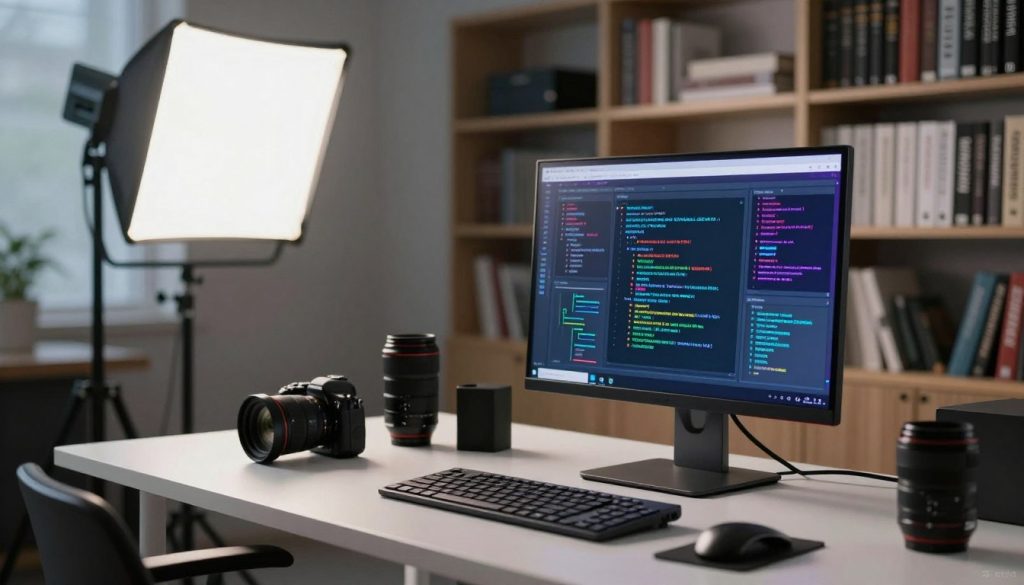
Learning to craft prompts is key to getting stunning, glossary hyper real images from AI. Choosing the right words helps the model understand and create your vision. This results in detailed and realistic visuals.
Positive and Negative Prompting Strategies
Good prompting balances what you want to see and what you don’t. Positive prompts tell the model what to focus on, like the subject and lighting.
Negative prompts help by removing unwanted parts. This keeps your image glossary hyper real by avoiding mistakes.
Weighting and Syntax in Prompt Construction
You can control the AI’s output with specific syntax. Most tools let you set weights for keywords. This means you can make certain details stand out more.
For instance, boosting “8k resolution” or “highly detailed skin” makes the model focus on those aspects. This syntax-driven approach is crucial for perfecting your image.
Tokenization and CLIP Embeddings
Knowing how AI processes language is essential for better results. The model breaks your prompt into tokens and maps them to a CLIP embeddings space.
Choosing your words carefully aligns your vision with the model’s understanding. This is how you achieve a glossary hyper real image that looks real and intentional.
Style Modifiers and Artist References
Adding specific style modifiers can change your image’s mood and texture. References to photography or art styles help the model use a consistent look.
By using these modifiers, you can make your AI images look more polished. Strategic referencing helps you capture the essence of real photography in your digital work.
Photographic Jargon and Camera Settings
Learning photographic terminology is crucial for creating realistic AI images. By using expert camera settings, you control your image’s look. This knowledge makes your digital creations look like professional photos.
Aperture, Depth of Field, and Bokeh Effects
Aperture is the lens opening that lets light into the camera. A big aperture (low f-stop number) makes the background blurry. This creates pleasing bokeh effects in portraits.
Focal Lengths and Lens Characteristics
Focal length affects your shot’s view and zoom. Long focal lengths, like 85mm or 105mm, are great for portraits. Wide lenses show more of the scene, adding depth and scale.
Shutter Speed and Motion Blur Simulation
Shutter speed controls light exposure time. Fast speeds freeze action, while slow speeds create motion blur. Knowing this terminology helps the AI capture the right moment.
ISO, Noise, and Grain Textures
ISO measures camera sensitivity to light. Higher ISOs can add digital noise, mimicking film grain. Finding the right balance is key to your image’s texture and mood.
Lighting Techniques and Environmental Realism
To achieve environmental realism, you need to understand how light interacts with surfaces. Knowing the terminology of digital lighting lets you control atmosphere and depth in your images. Proper light placement can turn a simple image into a professional-grade visual.
Global Illumination and Ray Tracing Concepts
Global illumination shows how light bounces off surfaces to light up shadows. This complex process makes scenes look more realistic by reflecting light onto surrounding areas. Ray tracing goes further by tracing light rays to create accurate reflections and refractions.
These methods are key to creating depth. Without them, scenes can look flat or fake. Knowing this terminology helps you control light in 3D spaces.
Three-Point Lighting Setups
The three-point lighting method is a classic for defining subjects clearly. It uses a key light for main illumination, a fill light to soften shadows, and a rim light to separate the subject from the background. This setup gives a balanced look, common in photography and digital rendering.
Subsurface Scattering and Skin Rendering
Subsurface scattering makes light penetrate translucent surfaces like human skin and scatter inside. This effect is crucial for hyper-realistic skin textures. Correct application avoids the “plastic” look often seen in low-quality renders.
Optical defects like chromatic aberration can occur when simulating complex lens behavior. This defect causes different colors to focus at slightly different distances. It can add a cinematic touch or degrade image clarity, depending on your intent.
HDR and Dynamic Range Management
High Dynamic Range (HDR) allows for a wider range of light and dark values. Effective management of dynamic range ensures that highlights are detailed and shadows have depth. Mastering this terminology helps maintain visual consistency across different lighting conditions.
| Technique | Primary Benefit | Visual Impact |
|---|---|---|
| Global Illumination | Realistic light bounce | Increased environmental depth |
| Three-Point Lighting | Subject definition | Professional studio aesthetic |
| Subsurface Scattering | Organic light absorption | Lifelike skin rendering |
| HDR Management | Exposure balance | Enhanced contrast and detail |
Anatomy and Character Consistency
To get perfect character consistency, you need to understand human anatomy well. It’s hard to keep a character’s identity the same in every scene. Knowing how the human body works helps make your characters look right and real.
Face Restoration and Upscaling Tools
Even top models can have trouble with facial details at low resolutions. Tools like GFPGAN and CodeFormer help fix issues with eyes or mouths. They adjust the original image to match a high-quality reference.
“True realism in digital portraiture is found in the subtle imperfections that define a human face, not just the absence of noise.”
Anatomical Correctness and Pose Estimation
To avoid weird limb positions, you need pose estimation tools. ControlNet helps guide the creation process with a skeleton. This keeps your character’s pose looking natural, like how CCD sensors capture images without distortion.
- Use OpenPose for precise skeletal alignment.
- Apply depth maps to maintain spatial relationships.
- Adjust weight settings to balance structural guidance with creative freedom.
Skin Texture Mapping and Pore Detail
For hyper-realism, skin quality is key. High-resolution upscaling can enhance skin textures. Knowing the right terminology for skin rendering helps focus on pore detail and natural light scattering.
Consistency in skin tone is crucial for a professional look. Don’t smooth the skin too much, as it loses its natural texture. Keep the texture maps that make your character’s skin unique.
Eye Reflection and Iris Detail
The eyes are essential for any portrait. Adding depth to the iris and accurate light reflections can make an image come alive. Understanding ocular anatomy helps prompt for specific highlights that mimic real-world lighting.
Always make sure the catchlights in the eyes match your main light source. This small detail adds the final layer of polish for true character consistency. When the eyes look right, the whole character seems more real.
Advanced Generation Workflows
Learning advanced generation workflows lets you control your creative work better. You can go beyond simple prompts to add details and grow your art. Knowing the terminology is key for top-notch results.
Inpainting and Outpainting Procedures
Inpainting lets you change parts of an image. You can hide a section and ask the AI to redo it. This is great for fixing things or changing clothes. Outpainting makes your image bigger by adding to it.
“The true power of generative art lies not in the initial prompt, but in the iterative refinement of the final output.”
Img2Img and Denoising Strength
Img2Img uses an image to guide new ones. The denoising strength is important. It controls how much the AI changes the image. More strength means bigger changes, less means it stays closer to the original.
Sampling Methods and Step Counts
Sampling methods are how the model makes your image. The right sampler can change the image’s look and feel. You also need to think about step counts. More steps mean more detail but take longer.
- Euler a: Great for quick, creative iterations.
- DPM++ 2M Karras: Excellent for high-detail, stable outputs.
- DDIM: Ideal for precise control during inpainting tasks.
CFG Scale and Guidance Control
The CFG scale controls how free the AI is to be creative. A lower scale means more freedom, a higher scale means it sticks closer to your text. Finding the right balance keeps your art true to your vision.
Post-Processing and Final Polish
Learning the terminology of post-processing is key to improving your AI-generated work. The initial creation is just the start. The final touches make your work look professional. These steps ensure your images are clear and impactful.
Color Grading and LUT Application
Color grading helps make your images look consistent by adjusting colors and saturation. Using a Look-Up Table (LUT) is a common way to apply specific color profiles fast. This terminology keeps your work looking cohesive.
“Color is a power which directly influences the soul.”
Sharpening and Contrast Adjustments
To make your images stand out, focus on sharpening and contrast. Sharpening tools enhance edges that may have gotten blurry. Adjusting contrast adds depth, making shadows and highlights balanced and realistic.
Artifact Removal and Cleanup
AI generation sometimes leaves behind small errors or noise. Artifact removal is about fixing these issues for a smooth, professional look. Paying attention to skin textures and backgrounds is crucial for quality.
Upscaling Algorithms and Resolution Enhancement
Lastly, you need to improve the resolution of your images. Upscaling algorithms, like ESRGAN or SwinIR, increase pixel count without losing detail. This is essential for large prints or high-definition digital displays that need sharpness.
Hardware and Software Environment
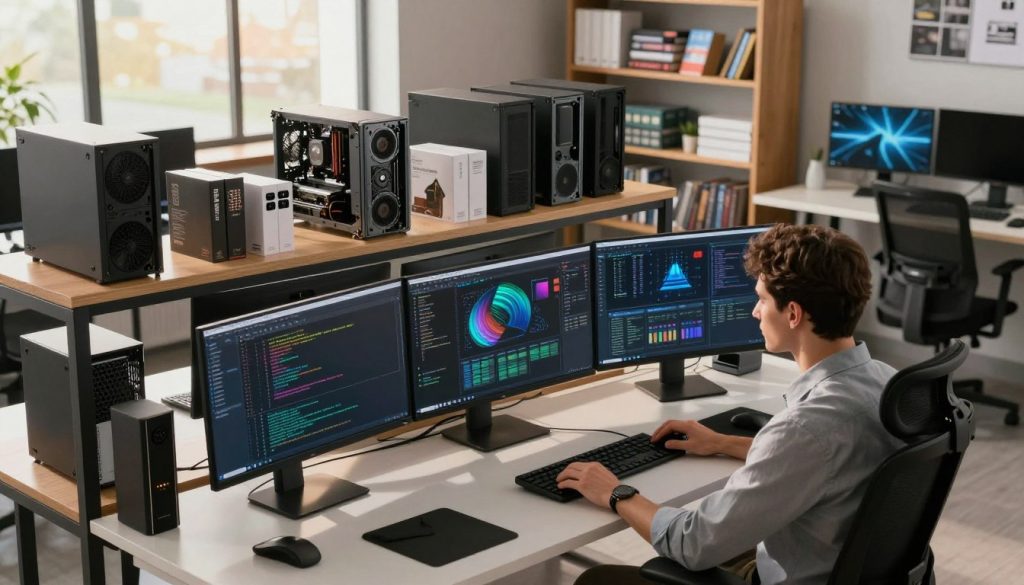
Getting to know the terminology of your workstation is key to top-notch results. Your work quality depends on how well your hardware and software work together. Digital cameras use CMOS sensors, while AI uses your GPU to create images.
VRAM Requirements and GPU Optimization
Your graphics card’s VRAM is crucial for detailed images. High-resolution outputs need lots of memory to work without freezing. Aim for a GPU with at least 12GB of VRAM for the latest tech.
When your hardware hits its limit, optimization is vital. Using xformers or sdp-attention can cut down memory use. This lets you make bigger images on less powerful hardware by improving data flow.
WebUI Interfaces and Extensions
Most people use WebUI to interact with generative models. It connects your prompts to the code. Learning the terminology of these interfaces makes navigating easier.
Extensions add new tools to your workflow. They can do everything from color grading to face restoration. Keeping your interface up to date ensures it works with the latest models.
Batch Processing and Automation
Batch processing is a must for making lots of variations quickly. It lets you run many prompts at once without watching each one. This is essential for testing different settings.
Automation scripts save time by automating tasks. They let you focus on making creative prompts. This approach leads to more consistent results over time.
Model Merging and Weight Blending
Model merging combines the strengths of different models into one. By adjusting weights, you can create a model that excels in certain areas. Knowing how to blend weights is crucial for unique art.
Blending models can mix realistic skin with specific lighting. This expands your creative options beyond a single model. Trying different ratios can uncover new possibilities in your models.
Troubleshooting Common Realism Issues
Mastering the technical terminology of troubleshooting is key for improving AI-generated images. Even with the best prompts, you might still see visual errors. Knowing how to spot and fix these issues helps keep your work top-notch.
Fixing Distorted Limbs and Extra Digits
Common problems include extra fingers or deformed limbs in generative art. Use Inpainting tools to cover up and redo these areas with a precise prompt. ControlNet with a pose-estimation model helps keep body shapes right.
“The secret to perfect anatomy in AI generation lies in the iterative process of refining specific regions rather than relying on a single pass.”
Correcting Unnatural Skin Tones
Characters with unnatural skin tones often come from wrong VAE settings. Make sure you’re using the right VAE file for your project. Adding “natural skin texture” or “subsurface scattering” to your prompt can help the model create more realistic skin.
Resolving Blurry or Low-Resolution Outputs
Blurriness usually comes from too much denoising during img2img. Try lowering the denoising value or use a high-quality upscaler to sharpen your images. Using the right upscaling algorithms keeps your images detailed, like pores and hair.
- Check your sampling method for stability.
- Increase the step count for better detail resolution.
- Apply post-processing sharpening filters if necessary.
Managing Model Overfitting
Overfitting occurs when a model becomes too specialized, leading to repetitive or distorted outputs. Adjusting LoRA files or blending models can help. Understanding how to blend weights is crucial for balancing creativity and structure.
Conclusion
You now know a lot about the technical terms needed for realistic AI image making. Using these terms can make your creative work better and more detailed.
Stable Diffusion and tools like Automatic1111 give you a lot of power. Knowing how to use these tools can turn a simple image into a work of art.
Keep trying new things with these techniques to improve your projects. Every change you make gets you closer to perfect images.
Share what you’ve learned with others. This way, you can see how they use these advanced methods. Your journey in creating high-quality images is just starting.
FAQ
How can I use photographic terminology to improve the realism of my AI-generated portraits?
To get a hyper-realistic look, use photography terms in your prompts. For example, changing the aperture (like f/1.8 or f/2.8) controls the depth of field. This creates a clear background effect, making your subject stand out.
Also, pick a focal length like 85mm or 50mm. This keeps facial features natural and avoids wide-angle distortions.
What role does subsurface scattering play in creating realistic skin textures?
Subsurface scattering is key for realistic skin textures. It’s used by tools like NVIDIA Omniverse and Stable Diffusion. It makes skin look natural, not plastic, by simulating how light interacts with it.
How do I maintain character consistency across multiple generation sessions?
For consistent characters, use LoRA models and ControlNet. Pose estimation tools like OpenPose help keep the skeleton right. IP-Adapter or specific checkpoints ensure the face stays the same, avoiding “face morphing.”
What is the difference between inpainting and outpainting in a hyper-real workflow?
Inpainting fixes parts of an image, like skin details. Outpainting adds to the image, creating a bigger scene. Both are important for a complete look.
Why is the CFG Scale important for following complex prompts?
The CFG Scale controls how well the AI follows your prompts. A lower scale means more freedom and smoother textures. A higher scale means strict adherence. Aim for a balance of 5 to 9 for the best results.
What hardware is recommended for efficient high-resolution rendering?
For big images, use an NVIDIA GeForce RTX series GPU with 12GB VRAM. This prevents memory issues when making detailed images at 4K.
How can I fix common artifacts like distorted limbs or "double heads"?
Distortions happen when images are too high for the model. Use Hires. fix for lower initial images. Negative Prompts help avoid “extra digits” and “fused limbs.”
What is the benefit of model merging in the pursuit of realism?
Model merging combines two models’ strengths. For example, merge a lighting expert with a precision model. This creates a “super-model” with the best features for your look.